



I have been on a bit of a library book spree. Every time I go, I get anywhere from 1 to 5 books, in addition to all the ebooks I have on hold. Not all these books have been winners! Indeed, a stack of four mostly untouched books is going back tomorrow. I’m a mood reader who reads multiple books at once; I pick them up and put them down for anywhere from days to years at a time before I pick them back up. Listen, I have two advanced degrees in English. If I couldn’t read this way, I would not have survived.
My digital copy of Butter by Asako Yuzuki, translated by Polly Barton, was ready in mid-May, shortly before a week-long trip back to the Denver area. Our flight out was incredibly early, so I watched Dimension 20 on my phone on the way out. Halfway through the trip, relaxing before bed, I pulled out my e-reader and decided to start Butter. Color me shocked when it told me it would be over 10 hours of reading time! I started and felt like I didn’t stop for several days. The plane journey home? Reading Butter. Every night before going to sleep? Butter. Odd moments during the day when I had some free time? Butter, baby. All I knew about the book when I’d requested it was that, recently, a friend of a friend mentioned it and said she didn’t think she could read it because it was about murder and food in a way that implied to me it was about cannibalism, or at least made some very unsettling food and murder metaphors. Naturally, I was intrigued and requested the ebook.
Dear reader: This book does none of those things.1
Butter is ostensibly a book about a Japanese journalist, Rika Machida, who gets caught up in the life of a convicted murderess named Manako Kajii. Manako invades Rika’s life and it changes drastically as a result, in ways both good and very bad. It is also so much more than that. It’s a meditation on thinness and society’s obsession with the size of women’s bodies; about food and how we prepare it and why; about finding community and happiness to sustain yourself; about feminism and relationships, both platonic and sexual, all with a not-subtle sapphic undertone. It is not a book that goes into gory murder details.
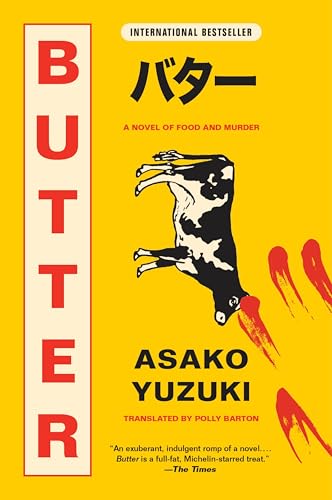
In fact, much like the real case it’s based on, the murders in the book could have been suicides (maaaaaaybe) and are generally not grisly. We do not hear much about the murders at all. Murder is the least explored theme of this book, in spite of the cover and the marketing machine that would make you think otherwise. The cover of the US edition contains a bloody handprint, which is never found in the book at all. It’s almost a shame that Butter has been marketed as a real-life murder mystery instead of what it actually is: A meditation on women’s bodies and women’s relationships with themselves and the people around them.
Manako proudly and loudly asserts she doesn’t need friends, hates women and feminism, and just wants to take care of men because they’re all helpless while she sits in a jail meeting room because she’s been convicted of killing three of them. She is also overweight2 and somewhat plain-faced, but she’s a magnet to many people, including Rika, and these men who wanted to be taken care of and who ended up dead in ways that could be dismissed as suicide. These men wined Manako, dined with her in fancy restaurants across Japan, gave her lots of money and anything else she wanted, and called her their girlfriend. They also said nothing but horrible things about her weight and looks to other people, like their families, yet to her, they were nothing but sweet and gave her everything she ever wanted … until they died. That’s a known trope to many fat people, trans people, queer people, POC, etc.
To our faces, they’ll be sweet, but behind our backs, they’re fucking wretched. It’s something Rika has never confronted until she begins her friendship of sorts with Manako.
Rika begins eating like Manako to understand her better (Manako ran a food blog before she was imprisoned). Food, particularly butter (shock!), was of huge enjoyment to Manako. She always ate what she wanted, when she wanted. Rika finds herself enjoying food and cooking for the first time in her life, but she gains a good deal of weight, leading to the dissolution of her “prince” persona and figure. Yes, prince. We get repeated passages about how Rika was the androgynous, handsome prince of her all-girls high school, and kept up that image until now.
Apparently, every girls’ school has at least one female student who takes on the role of looking/acting like the prince, and every other student has a crush on her, until they grow up and know better. Sure, Jan. Rika has proudly kept her figure trim, lean, and androgynous, until she begins cooking and using/eating lots of butter, instead of the convenience foods Rika had lived on for years as a non-cook.3 Rika is distressed because she does not know who she is if she’s not a prince to the people around her. Her best friend, Reiko, also laments about how she had been in love with Rika in high school, though Reiko is now married to a man. She literally says, “If only Rika were a man,” more than once. As the reader, I was sitting there saying, “NOW KISS!!!!!!” to Rika and Reiko for about 90% of the book.
I was a bit taken aback by the rampant fatphobia displayed by most of the characters, including by Rika herself when she first gains weight. Everyone has something to say about Rika’s changing body: Reiko, her boss, her situationship, coworkers. It is insane and so, so familiar and heartbreaking. Eventually, though, Rika settles into an “I don’t give a shit” attitude, which made me quite pleased. She’s happy with her body, so who cares what anyone else thinks? You know what tastes better than skinny feels? High-quality butter.
There’s also a good deal about trauma in this book, and how our past trauma shapes our future to some degree, particularly if we run from it. Rika’s father passed when she was a teenager, and the trauma surrounding that event has shaped her entire life. Manako, similarly, has family trauma in her past, though she vehemently denies it and reframes it in a way that projects her as tough. Reiko also has trauma with her parents that has shaped her marriage and caused her a lot of trouble now as an adult. I have many, many thoughts on this, but would absolutely ruin the book if I got into it here. Broad statement: Trauma follows all of us, and we have to handle it, or it’s going to handle us. Roughly.
There is so, so much more plot to discuss and so many more sapphic/bisexual undertones to be explored, but I can’t do that without spoiling a whole lot of the book, and I won’t do that to you. If you’re looking for a hardcore murder mystery, this is not the book you want. If you’re looking for a fictional take on a popular crime from Japan, I still don’t think this is the book you want. If you want to wrestle with questions about society, food, trauma, bodies, relationships, work, and how women handle these things to the best (or worst) of their ability, then you should read Butter immediately.4 Just make sure you eat something delicious and preferably slathered in high-quality butter while you read, because you absolutely will get hungry.
- You want a ladycentric book about cannibalism? A Certain Hunger is going to scratch that itch quite well. I’m about to start Greedy, which is also apparently a book about murder and food, I think, in the vein of A Certain Hunger. At the very least, the front cover of the book boasts that it’s “Not suitable for vegetarians,” so I’m probably going to like it. ↩︎
- Though I did the conversion, and she apparently only weighs like 150 pounds?!?? Allegedly, she’s quite short, but like … that doesn’t seem that big, kids. ↩︎
- Yes, there are lots of descriptions about butter itself and butter on food. It will make you crave butter; you have been warned. ↩︎
- Granted, with a specifically Japanese bent, but considering so many books are set in the US imperialist mindset, and the fact that these are universal issues we’re all wrestling with in different ways, you can deal. ↩︎