


If there’s anything the moral arbiters responsible for banning the Video Nasties feared and loathed, it was movies about cannibals. Movies that actually had the word “cannibal” in their titles may as well have painted juicy targets on their backs. Hell, there was even a Video Nasty with the English title The Cannibal Man that featured no cannibalism whatsoever.
Cannibals Holocaust and Ferox, though, worked overtime for their Nasty medallions. Cannibal Holocaust (Ruggero Deodato, 1980) almost got its director prosecuted until he could prove no humans in the film had died for real (animal deaths were a different story). And Cannibal Ferox (Umberto Lenzi, 1981) carried one of those mad, bad, dangerous reputations on the schoolyard, especially under its sometime American moniker Make Them Die Slowly. (“So, like, I saw this movie Make Them Die Slowly?” — in my neck of the woods they claimed they saw it in the Combat Zone in Boston, not implausible in the ’80s —”Dude, it was fuckin’ sick,” and then you’d get a gross-parts-only capsule review. I was 13 in 1983, when Ferox finally got US distribution, and I definitely remember being part of those recess storytimes.)
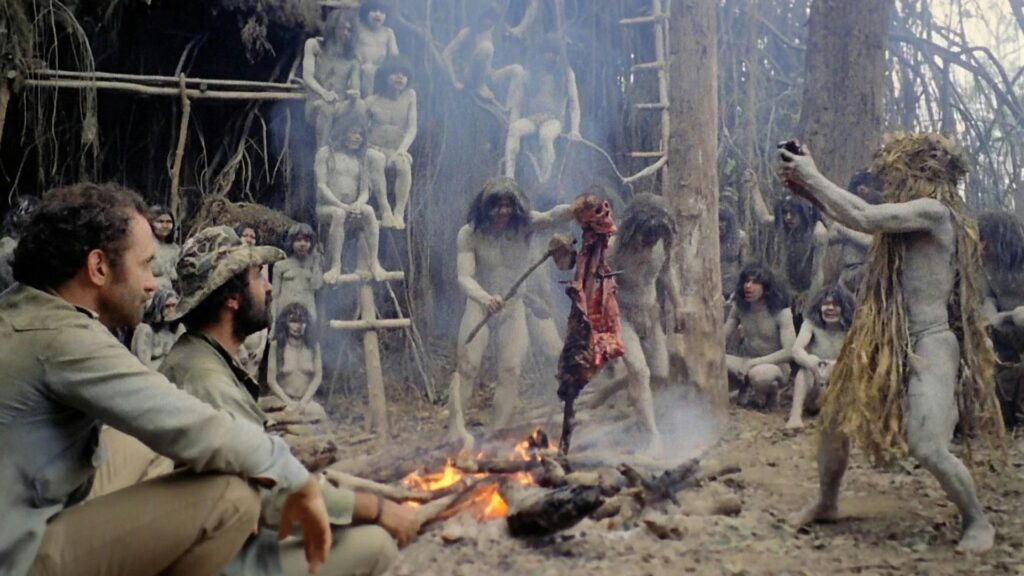
“Cannibal Holocaust,” I wrote when reviewing it some twenty years ago, “may be the nastiest of the Video Nasties.” I meant that both in the literal, descriptive sense (much of it is extremely nasty) and in the thematic sense. It’s got a Message: “I wonder who the real cannibals are?” It is a serious work as much as any of these ’70s-’80s Italian gut-munchers were serious. It also uses the “found footage” trope about twenty years before The Blair Witch Project did, so it calls out our complicity as viewers. It turns our voyeurism into horror, and then exposes our horror as hypocrisy.
It didn’t go any easier when I rewatched it for this column. Full of ultraviolent rape and footage of animals actually being killed/mutilated (we’re assured the animals were subsequently put to use as food), Cannibal Holocaust is far from a placid or fun watch. I’d have to imagine it would take a very coarse sensibility to consider it something you pop in for shits and giggles. It’s a ride, and a bumpy one.
The narrative takes two tracks. In the first, an anthropology professor (Robert Kerman, aka old-school porn star R. Bolla of Debbie Does Dallas) investigates the disappearance of four documentarians — three guys and a woman — in the Green Inferno, a hell-blasted spot of South America where three warring tribes live. The professor finds the documentary crew’s film cans and gets them back to New York, where a network is champing at the bit to air the found footage, sight unseen. Well, once the sight is seen — showing the four westerners as equally savage as the “savages” they’re documenting — the sickened network execs do a fast fade, the footage is ordered burned, and the professor lights his pipe pensively and looks crestfallen.
The crew is presented as exploitative, impulsive jerks from the get-go. The natives they encounter aren’t saints either, judging from the repulsive rituals they carry out, punishing women for their sexuality. Kerman referred to director Deodato as a “sadist,” and Cannibal Holocaust does suggest a dark and nihilistic worldview. Everyone’s a cannibal with intestines oozing between their teeth, whether they speak English with cultured diction or communicate via grunts and chants. The Americans act out a ferocious cultural appropriation of what they assume “savages” would do, without context or understanding. The film’s viral image shows the corpse of a woman impaled into her vagina and out of her mouth, and we assume the natives did it to “punish” her for having been raped, but we can’t say for sure the men on the film crew didn’t do it. Fair warning: The movie may well put you in a mood. It sure does make a lot of what came later (from Blair Witch to Eli Roth’s The Green Inferno to Natural Born Killers) look safe and naïve in comparison.
The score by Riz Ortolani (of course some of his stuff ended up on Tarantino soundtracks) splits the difference between orchestral, acoustic guitar, and ominous synthesizers. Somehow, even when the actors falter and can’t put across the illusion of reality, Ortolani glues it all together. We don’t question where the score comes from (obviously it’s not on the crew’s original footage); it’s non-diagetic music over supposedly found footage, yet we accept it because the melody is the closest thing to beauty in the world we’re shown.
God knows most of the rest of it is excruciatingly ugly, which gives it some purchase as a work of art as well as a horror classic. There are some scenes that just feel wrong to be watching; it has the tone and realism of real carnage happening, the cold thrill of the forbidden, even in the scenes that don’t involve real animal snuff. The outfit that took it under its wing 25 years ago, Grindhouse Releasing (pour one out for Sage Stallone), actually offers a version without all the genuine animal butchery, but I think if you’re going to buy a ticket for this ride, you’d better be prepared for the full shit. Some people won’t be, and that’s fine! I certainly don’t relish watching a screeching coatimundi being sliced open, but that ghastly stuff is part of the tapestry of violence explored here.
Eventually, in what may be the last word in vengeful contempt and revolt, we see what happened to the crew, and we can’t say we blame the natives.
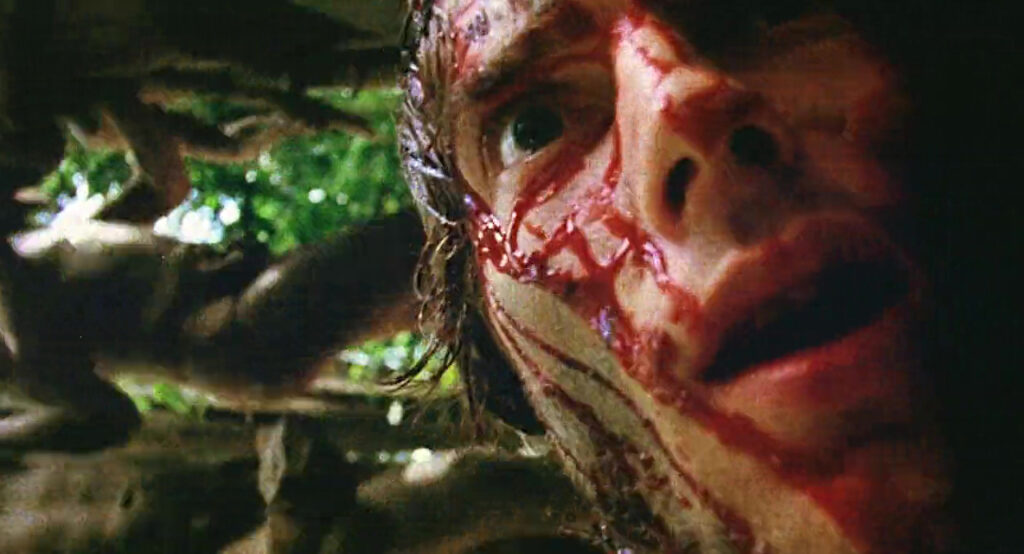
Anyone who’s seen it knows why Cannibal Holocaust was a Video Nasty. Like many Nasties, this one eventually passed the censors’ gauntlet, albeit with one cut. To this day, the footage of that sliced-and-diced coatimundi is banned in the UK, but otherwise the movie passed muster in 2011. That means the British powers that be apparently have no problem with the seemingly endless repetition of rape (to be fair, it’s always presented as cruel and monstrous, not titillating in any respect), not to mention the Americans torn apart and scattered to the four winds, but unzip one coatimundi…
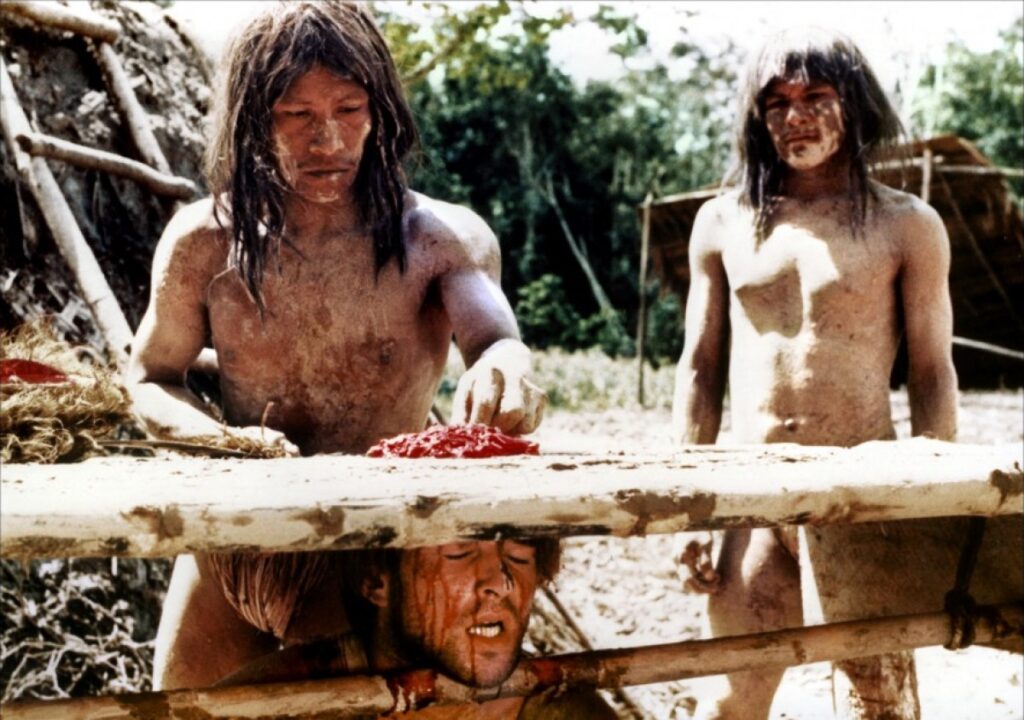
Kerman returned (in a smaller role as a cop) in Cannibal Ferox, which dispenses with most of the political import and just tells a gruesome story about cannibals vs. white intruders. Ferox‘s reputation, as noted above, preceded it; its American distributor, the grindhouse outfit Aquarius (Silent Night, Deadly Night), claimed in the ads, “Banned in 31 countries!” (As Michael J. Weldon, Psychotronic historian, once commented about a similar ad’s claims, “I’d like to see a list.”) Well, for a while Ferox was banned in the UK. What were the other 27 countries? Eventually Brits did get to see Ferox in 2013, minus about two minutes of animal cruelty. This is starting to become something of a theme. I’m reminded of a David Cronenberg quote (the man has one for every occasion): “It’s not just ‘Let’s show someone killing a pig on screen and we’ll get a good reaction.’ You would. So what?”
Cronenberg’s placid deep-shiv diss kind of sums up my view of movies like this that have no other way of shouting above the crowd other than crude shock. Even Deodato later allowed that the animal fatalities in his film were “stupid.” And his movie showed how the natives and film crew, warped by each other’s influence, kept upping the ante on “savagery.” But Ferox‘s dish isn’t nearly as deep — it could as well be an unusually gruesome crime-and-revenge poliziottesco.
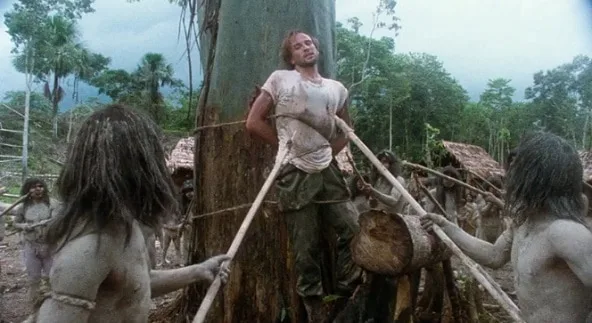
It begins confusingly enough to fool a first-time viewer into thinking this is merely a gritty Italian crime movie. A junkie looking for his dealer is killed by Brooklyn mobsters also looking for the dealer. (During the opening credits, the junkie passes by this semi-famous guy on 42nd Street.) We learn the dealer, Mike (John Morghen, born Giovanni Lombardo Radice), fled and is hiding out in the Amazon with an associate. They happen across another party, a student, Gloria (Lorraine de Selle), her brother (Danilo Mattei), and their friend (Zora Kerova), who are there to prove Gloria’s thesis that cannibalism doesn’t exist except as a cruel myth perpetuated by colonialist attitudes. The movie’s events will disprove the entire fuck out of Gloria’s thesis.
Most of these gut-munchers dawdle for an hour or so while working up to a splattery grand finale, and this is no exception. It seems front-loaded with scenes of animal death — Ferox adds animal-on-animal violence. There is a tribe nearby that mostly keeps to themselves until Mike betrays their trust. (Giovanni Lombardo Radice overacts entertainingly, making me wonder if Trey Parker ever saw this film.) They learn from Mike that white people are animals, and treat them accordingly. Castration, behanding, and lopping off the top of the skull to eat the brains are all on the menu, and that’s just one person. The hanging-from-hooks-in-the-breasts bit from A Man Called Horse is also taken for a drive here.
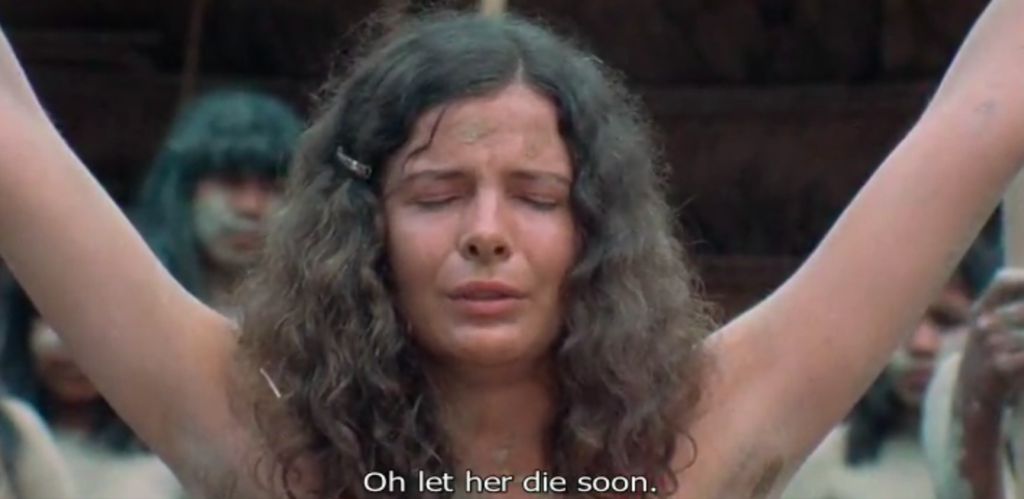
The score, by Roberto Donati and Flamma Maglione, is sometimes hilariously funky; it’d actually make a good dishwashing playlist. There’s more simple entertainment here than in Cannibal Holocaust; there’s no found-footage conceit, so no sense that we’re being called out for the brutality, and, thank the gods, there’s no rape. Not that Ferox is a breezy, pleasant film. There’s plenty of eating of freshly-killed animals, a native snacking on live grubworms with his mouth open, a seriously nauseating sequence wherein an anteater is crushed slowly to death by an anaconda, and of course the cannibalism Gloria wants to think doesn’t exist. Writer-director Lenzi actually sets up opposing philosophies: Mike the vicious and mercantile, Gloria the intellectual and optimistic.
Who wins? I’d say they both lose.
Movies like Cannibal Holocaust and Cannibal Ferox, which likely wouldn’t be mistaken for politically correct, still emphasize the whites’ complicity in their own doom. Are they … are they woke? Why, yes, they are. Cannibal Ferox is woke! The movies might not claim the natives are morally superior to the whites, but they definitely don’t claim the whites are morally superior to the natives. Ferox might be more vehement in its verbal messaging, and Holocaust has the stylistic edge of creepy cinema verité atrocities. They’d make an intriguing, if draining, double feature. For the trifecta, tack on Lenzi’s The Man from Deep River (1972), which started the whole messy cannibal subgenre. And while you’re at it, check out “Nasty” by the Damned, with bonus Evil Dead II insanity. (Evil Dead II was never a Nasty, though.)