


We’ve all seen roughly 7,000 episodes of Law & Order. Five hundred seasons in, it was still one of the hottest shows on TV. My personal favorite era is the Detective Ray Curtis (Benjamin Bratt)/ADA Abbie Carmichael (Angie Harmon) season because they’re both gorgeous1, but I’ll watch nearly2 any old season of any of the show’s iterations if given the chance.
I recently discovered both the 24-hour Murder, She Wrote and Law & Order original flavor channels on my TV, where they air the shows in sequential order with mild commercial interruption. Mid-binge the other day, a flash of something came to my memory: Wasn’t one of the ADAs on the show gay? I immediately started research.
Yes, indeed, ADA Serena Southerlyn is, canonically, a lesbian. But you’d sure as hell have to look closely to figure that out, even with exquisite gaydar. We don’t actually find out until the last scene of the last episode she appears in, and the internet was outraged when it happened. However, the Law & Order showrunners did lay some small clues along the way.
Law & Order started airing in 1990, and watching old episodes, it’s fun to see them tackle things like the internet, email, cell phones, and cyber crimes before the tech was commonplace. I recently watched an episode where a teenage boy racked up over $50k on his parents’ credit cards chatting for $2.99 a minute with a female brothel owner. The detectives make fun of the idea that the boy is addicted, with Detective Lennie Briscoe (Jerry Orbach) quipping that “everything is an addiction now.” Ah, the early 2000s. What a time.
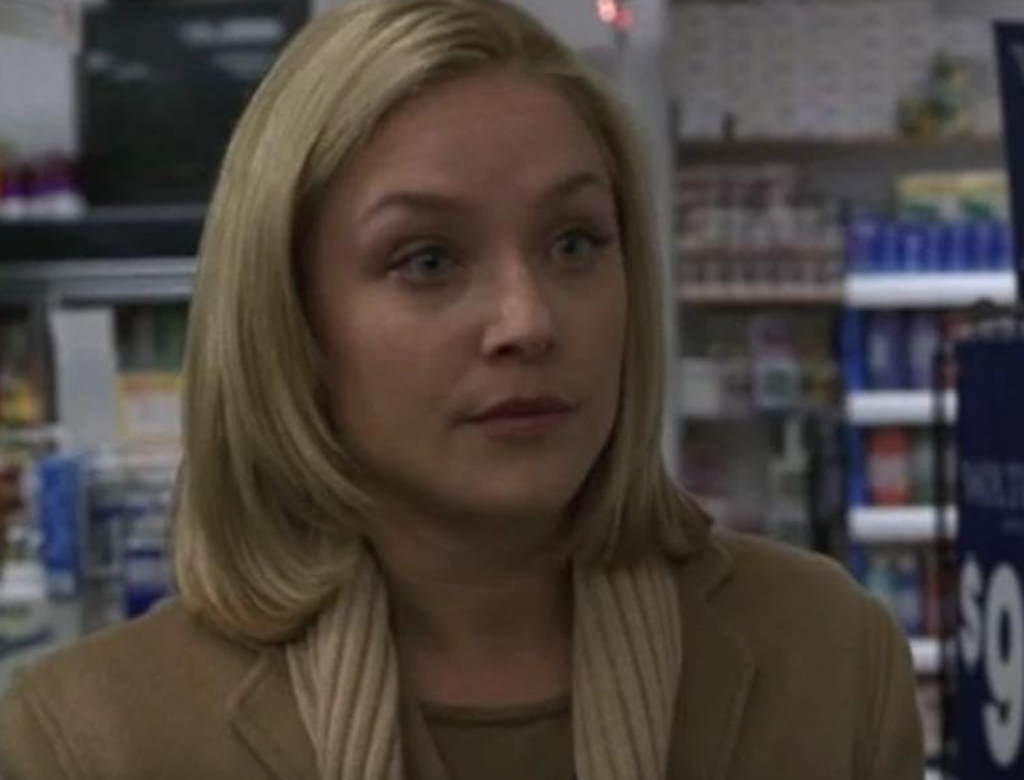
In season 12, we’re introduced to Serena Southerlyn (Elisabeth Röhm), the new ADA assisting long-tenured executive ADA Jack McCoy (Sam Waterston). She’s replacing Abbie Carmichael, whom I loved even though she’s a hardcore Texas Republican, mostly because Angie Harmon played excellently against Sam Waterston. Their dynamic was excellent, with Waterston regularly going behind her back to make his point anyway. Plus, Angie Harmon is just gorgeous, and I’ll watch her in anything.
Being such a staid and rather uptight person, Carmichael’s skirt-suit sets were generally grey, black, or otherwise neutral in color; she was brunette with long, sleek hair; beautiful; and extremely tough. By contrast, this is Serena next to McCoy, who is in probably the same suit he’s been wearing since he started at the DA’s office:
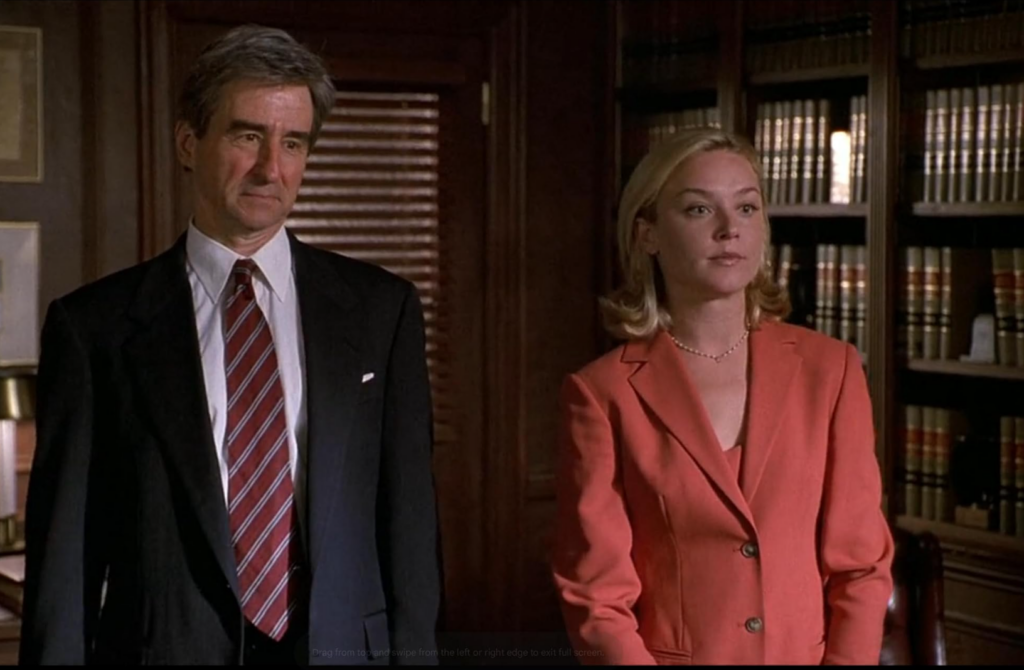
It’s clear they are trying to differentiate her from Abbie. Serena is practically wearing a clown costume with that coral-colored number in the world of Law & Order. Plus, she has a bouncy blonde bob, and she’s a softer sort of beautiful compared to Abbie. Does that mean she reads as overtly queer? No, but I’d argue that they’re clearly marking her as “other” from the jump.
As Serena becomes more ingrained into the world, she seems to become more of what we expect from an ADA. Her clothes are toned down, and she makes vague references to old boyfriends, but doesn’t appear to be currently dating anyone. She makes a comment in an episode about the bravery of coming out, which was huge for early 2000s prime time TV. There are other, more subtle clues, but the most obvious occurs shortly before she leaves the show.
In the season 15 episode “Gov Love,” the governor of Connecticut’s wife is murdered. While investigating, it turns out the governor was cheating on his wife … with a man, and she found out. That man’s boyfriend is who, allegedly, killed the wife. During the trial, it turns out the two men were married just months before, so they cannot testify against one another due to spousal privilege.
The governor ends up resigning from his job, which Serena and Jack watch on TV. She says, “He had to hide his sexual orientation to accomplish his goals.” Sound familiar? “Sexual orientation is not a license to be dishonest,” Jack retorts. Serena just smiles. “See you in the morning,” she says, and leaves. Well that sure seems like a clue!
Jack sends Serena to check that the marriage is legitimate, and she seems doubtful, if not resentful, perhaps as if she’s being asked to do this errand because she herself is gay. She’s openly hostile with the mayor who officiated over 200 gay weddings. As he tells her when she says he’s legally only allowed to marry “men and women,” “the statute doesn’t say anything about gender. This is a legitimate marriage under Article 3 of the Domestic Relations Law.” Serena tells him, “I admire your creativity.” He tells her that the United States will have gay marriage eventually. He also admits there’s an injunction from a county judge and that’s why he can’t perform any gay weddings for the moment, but the ones he has already performed are valid.
After, she has lunch with the right-wing judge who filed an injunction against the mayor. He’s very homophobic. She asks him if his injunction impacted marriages “that were already consummated,” and he leaves in disgust. Good. Serena returns to tell Jack that, yes, their marriage was legal and they have “no choice but to respect the [spousal] privilege.” “Or attack it,” Jack says, to her horror.
Serena says, “I just want to go on the record that a private conversation with your partner, gay or straight, should be kept confidential.”
“That’s not what the law says, and that’s not the legal position I’ll be taking,” Jack retorts. “You’re going to argue the privilege should only apply to heterosexual relationships?” she asks him incredulously.
“To put a murderer behind bars, yes … Leave your opinion about sexual politics at the water cooler, and help me win this case!”
Wow, Jack. Wow. If all of this isn’t a sign Serena wasn’t at least an ally, nothing is. Anyone sticking up for gay couples in the early 2000s was automatically classified as gay, even if they weren’t actually. Times were different, and yet, so much of this episode still rings true.
Jack decides that he needs to nullify the marital privilege between the two married men. Serena is horrified and fights with Jack and Arthur about this scenario. She asks Jack if he plans to invalidate “every one” of the gay marriages.
“If that’s what it takes,” he says.
“What, are you making social policy now?” she fires back.
Arthur supports Jack because “marriage is a state matter.”
“Our job is to put [this man] behind bars, not to fight the culture wars,” Jack says when Serena says they will set gay rights back by 20 years.
“I don’t think I’m going to be much help to you up in Albany,” she says as she leaves the room.
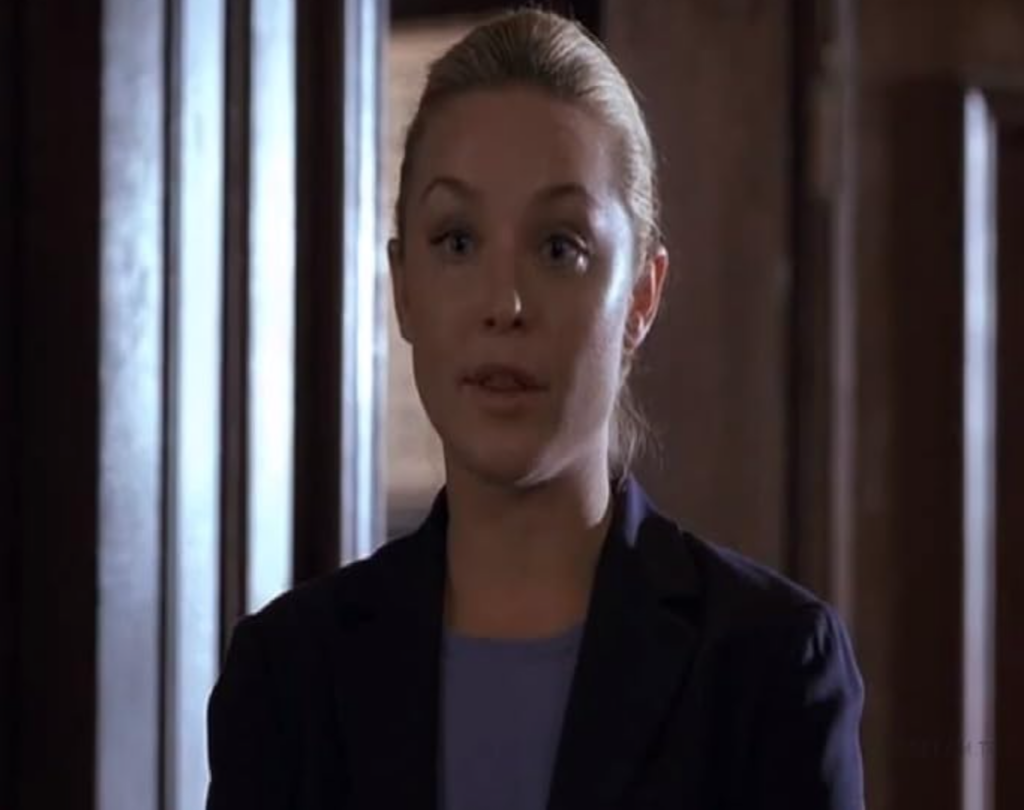
True to form, she does not show up to help Jack when he argues before the New York State Supreme Court that gay marriage isn’t valid in NY. He wins, meaning that he has nullified gay marriage in the state … in order to get this man to testify. Clearly, Serena was not happy about any of this. This episode was their way of coding Serena as gay, and honestly, it worked. PS: This backfires spectacularly for Jack, and he has to plead out the murderer on a lower charge with a deal, instead of a full trial conviction.
In the middle of season 15, just six episodes after “Gov Love,” we get an episode titled “Ain’t No Love,” which seems relevant both to the recent episode regarding LGBTQ+ marriage rights and that Serena is fired at the very end of this one. Throughout her time on the show, we’ve gone through a couple of district attorneys, and by season 15, it’s Arthur Branch (Fred Thompson). He’s a rather hardcore right-leaning Southern man, bringing that toughness we lost when Abbie left, except he’s the man actually in charge. His decisions are what Jack and Serena have to execute, and she’s been butting heads with Arthur for a while.
Arthur calls her into a meeting with him. He believes she’s too “emotional” for the job, “too passionate,” and he fires her. She immediately asks him what has become an iconic question: “Is this because I’m a lesbian?”
“No, no. Of course not. No,” he says.
“Good…. good,” she answers with a small smile and a head shake.
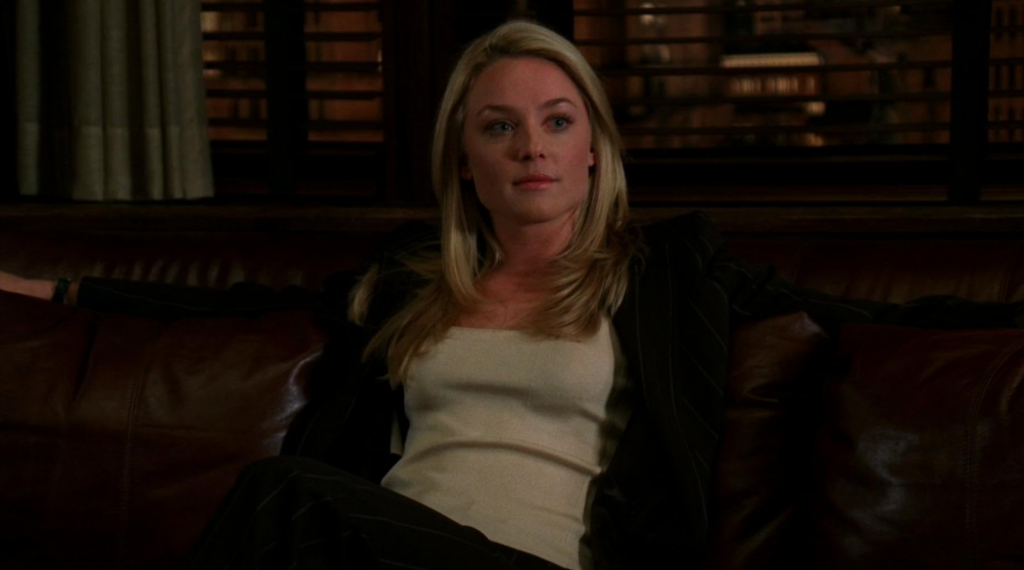
Looking at her in this scene, she’s fully assimilated and in great straight-person drag. Her hair is grown out; she’s in all black; she confidently gives Arthur her opinion. She’s practically a blonde Abbie, but she was hiding something from us the whole time. Or was she? I’d argue that being seen as “too emotional” and “too passionate” is not only a canon event for women, it’s also a canon event for the queer community. Queer people are constantly seen as overdramatic, erratic, over the top. You ever watch The Birdcage, for example? Ever seen The L Word? Broad City? The Ultimatum: Queer Love? I can give a million examples of how that trope plays out across the queer spectrum and impacts all of us.
I actually understand why the “too emotional” part triggered her to ask that question. When the episode aired, however, the backlash was immediate and intense. Many did not understand; others were just happy she was leaving as they determined her acting to be lackluster. Most were just shocked and confused and determined it was done for shock value. Dick Wolf himself asked if she wanted to “go out with a bang or a whimper,” and I think we know which one Rohm chose.
Was it just a last-minute decision? Was she a lesbian the whole time? Does it actually matter? We’ll never know for certain, but considering the way she toned herself down to fit in at the DA’s office, it doesn’t seem a stretch to me to say she was queer the whole time. Serena didn’t owe being out and proud to the Law & Order audience. Just because she didn’t “look” or “act” like she was a lesbian doesn’t mean anything, because there is no one way to look or act queer. Of course, this was the early 2000s, and mainstream depictions of queer people were Will & Grace and the original Queer Eye For the Straight Guy. The L Word was just happening and really showing a version of queer women for the first time on television.
Plus, if Arthur Branch was my boss, I’d stay in the closet, too. In fact, most people at most jobs I’ve worked haven’t known that I am part of the alphabet mafia. It’s work. It’s separate from my personal life. Maybe that was the case for Serena, too. No matter what, she announces herself as a lesbian, which means that in my book, she is absolutely queer. And, just like me, you probably forgot.
- It’s season nine if you also have exquisite taste in actors. ↩︎
- RA got me into Slim Bone Head Volt, and I love D’Onofrio as an actor, but I have a hard time watching more than an episode or two of Law & Order: Criminal Intent for some reason. ↩︎