

Glory be to Otis in his heavenly Office1, Fat Bear Week is upon us. We fucking made it, team. The world’s on fire (literally), but the superstars up at Katmai National Park are still doing what they do best: being bears.
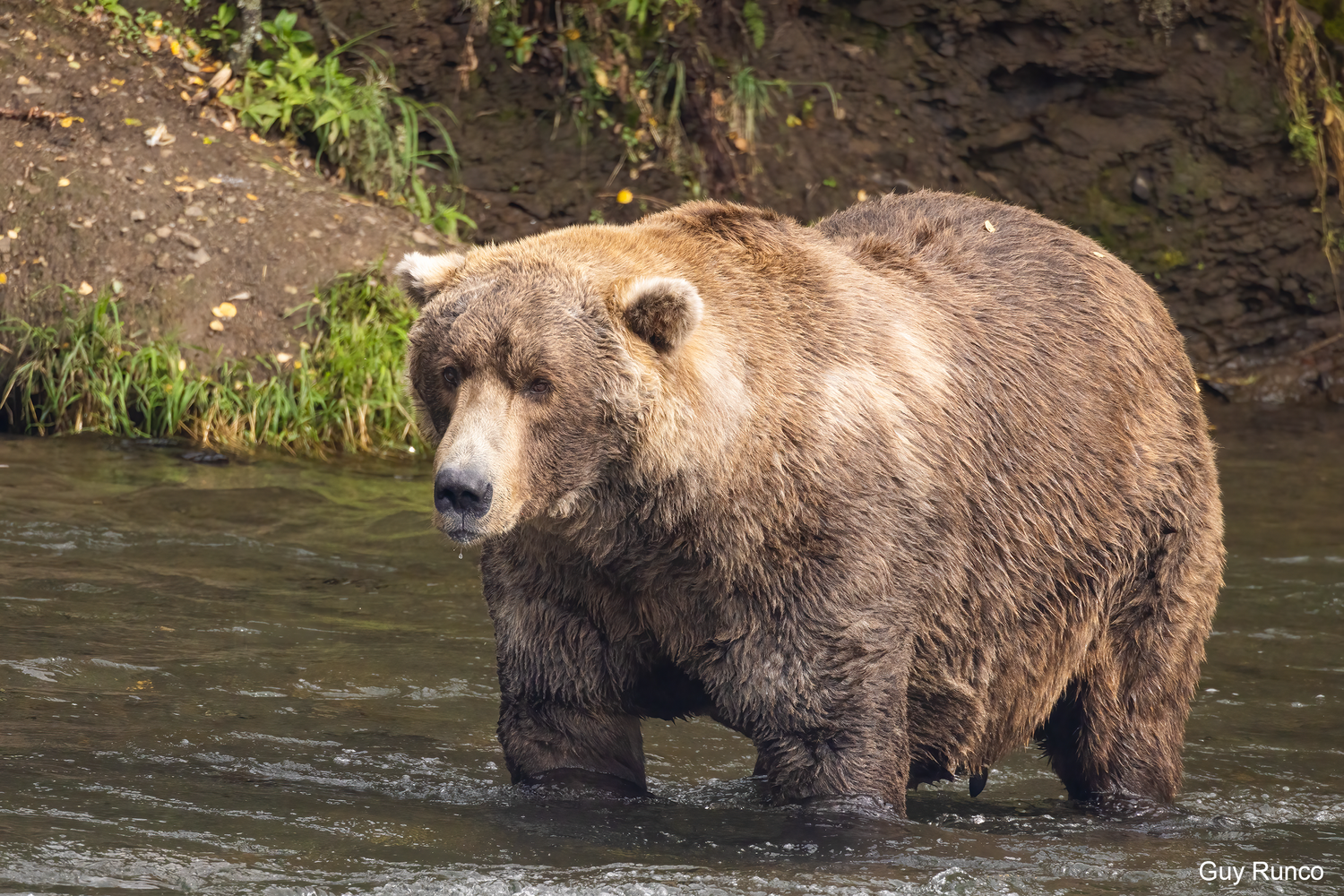
Today, a mind-boggling number of people tune in to watch the bears go about their bear business on the explore.org live cams. Dedicated bear watchers exchange bear lore and campaign for their favorites, and every season a handful of lucky fans are selected by lottery to make the pilgrimage to Brooks Falls in Alaska to experience these earth-bound gods from the viewing platforms.
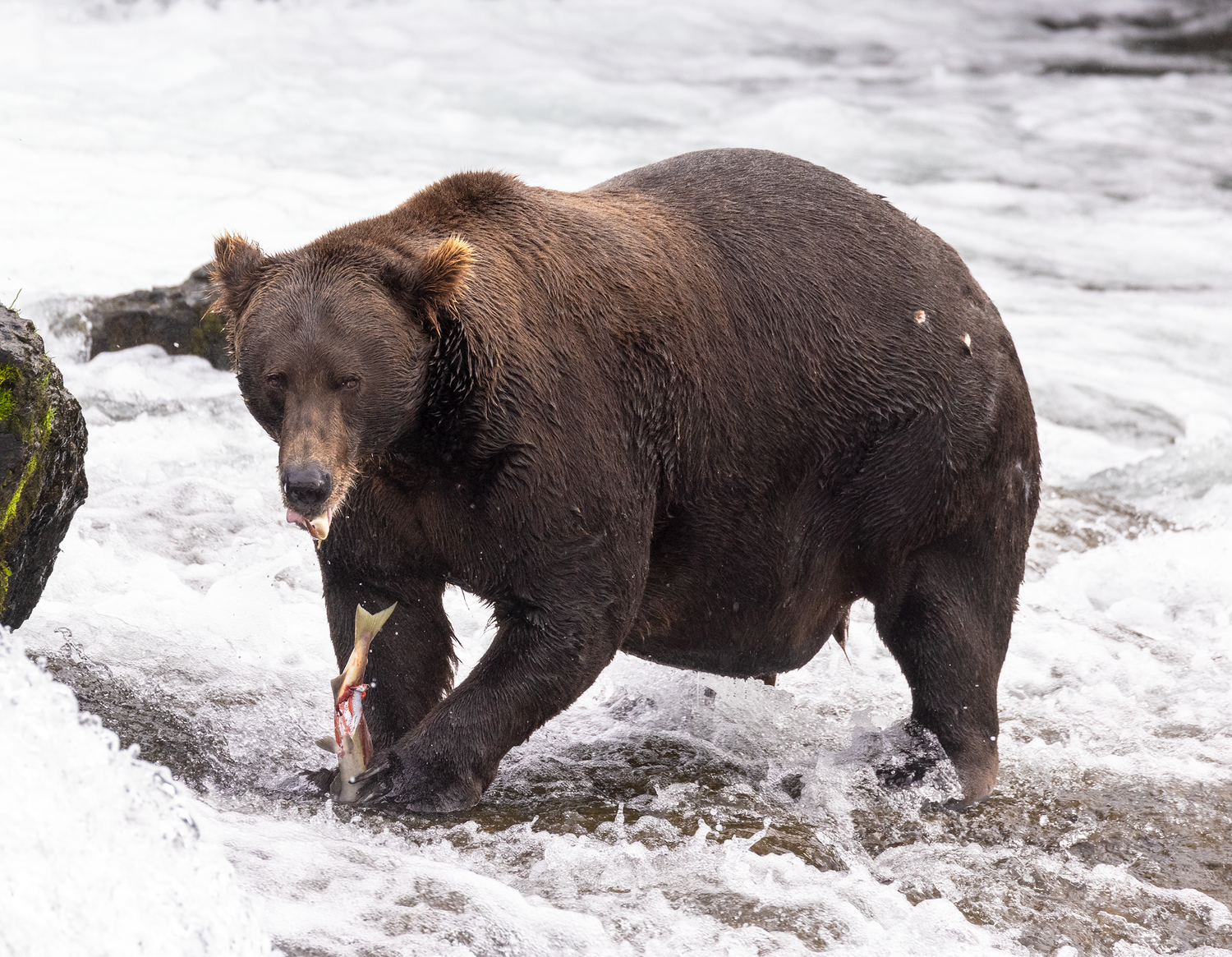
Each fall, bear fans worldwide vote to decide who will be crowned the “fattest,” which could mean the bear who overcame a challenge (say, Chunk persevering through a broken jaw) or the bear who is literally the most rotund (also Chunk any given year). There’s a pregame matchup too called Fat Bear Junior for the cubs.
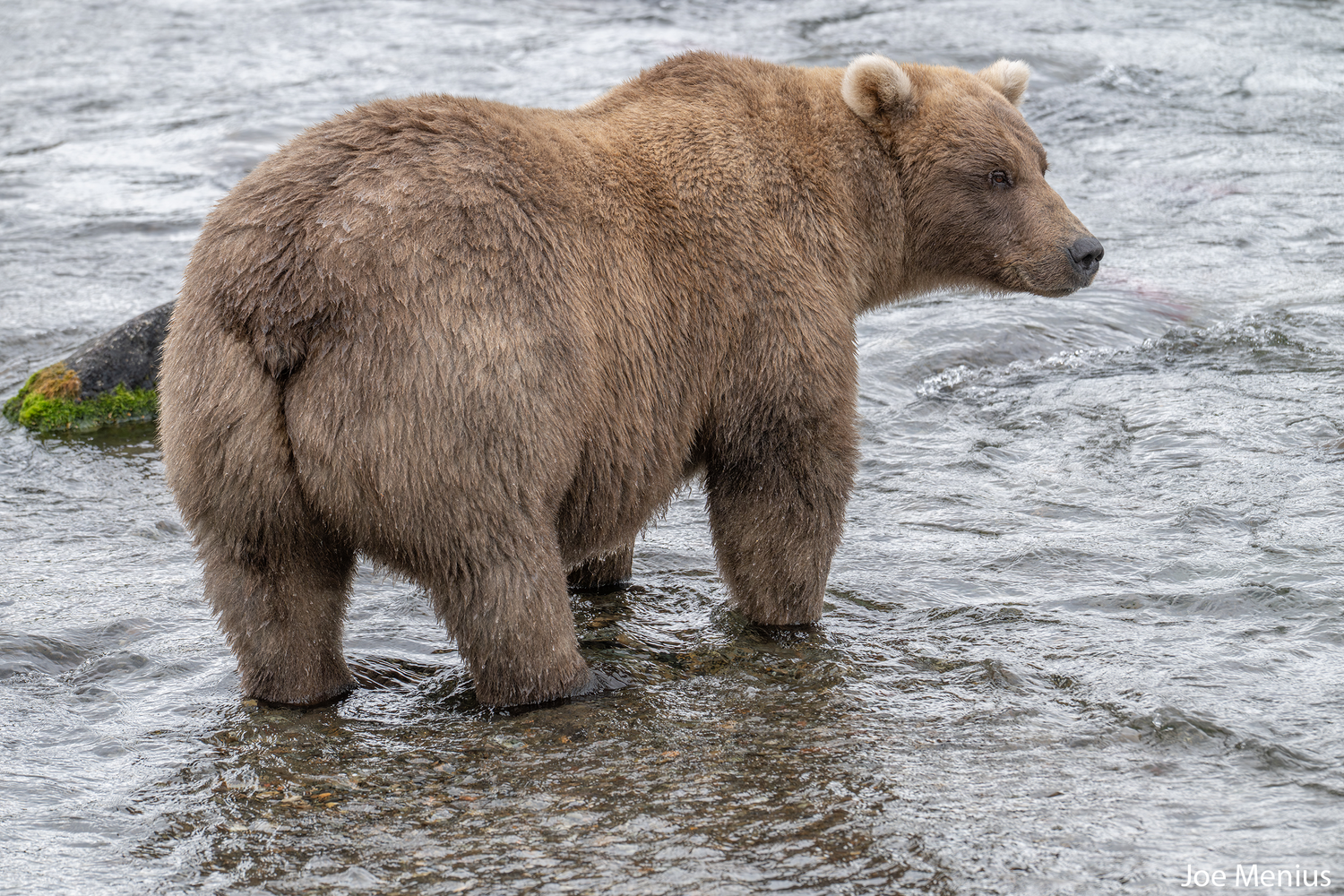
While Fat Bear Week, the ultimate awareness conduit and fundraiser, is their current claim to fame, Katmai is an official national park dedicated to preservation. When it comes down to humans vs. bears, the bears come first at Katmai, and this rule is ironclad. Human interference is strictly prohibited, and the bears dictate human movement. A “bear jam” is a wholly valid reason to be late for work. If a bear is sitting in the road, so are you, until the bear decides to move on. The sole exception to the “no interference” rule is if a bear is in distress because of something human-caused, as with the rescue of Divot, who wandered out of the park and got caught in a wolf snare.
This pro-bear attitude wasn’t always the case. As recently as the 1960s, the halcyon days when no one really gave a shit, bears were seen more as It’s A Small World puppets than complex creatures to be treasured. Leaving food and trash out was the norm, and in some places, it was done intentionally to attract bears for photo ops. Predictably, there were consequences, and, on the night of August 13, 1967, two women were brutally mauled to death in Glacier National Park in separate incidents in what became known as “The Night of the Grizzlies.” Several bears were hunted down and euthanized. The one responsible for the second attack was emaciated and had been suffering from excruciating injuries caused by eating glass. This caused a reckoning. New rules were put into place about feeding bears (DON’T) and locking up trash (DO), and there were sincere efforts to educate the public on the dangers of blithely leaving Oreos out while camping.
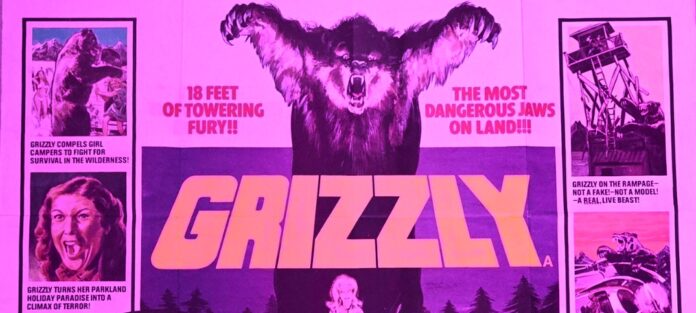
Not long after the Night of the Grizzlies, but long before the first Fat Bear Week, the film Grizzly (1976) was released. You’d be forgiven for assuming it was inspired by the tragedy at Glacier National Park, and it seems like a lost opportunity for a “based on a true story” tagline. From what I can tell, Grizzly was almost wholly based on “Jaws made a metric fuckton of money, so what if Jaws but bear?”
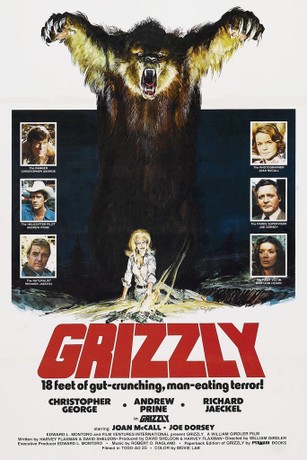
“What if Jaws but bear?” as a get-rich-quick scheme sounds naïve and deluded in a “my toddler could out-paint Jackson Pollock” sort of way, but it actually worked. Grizzly made $38 million against a $750K budget. That’s not bad for an indie rip-off featuring the ever-game Andrew Prine, a crew member wearing a furry sleeve reminiscent of a degloved Rock-afire Explosion animatronic, and not much else.
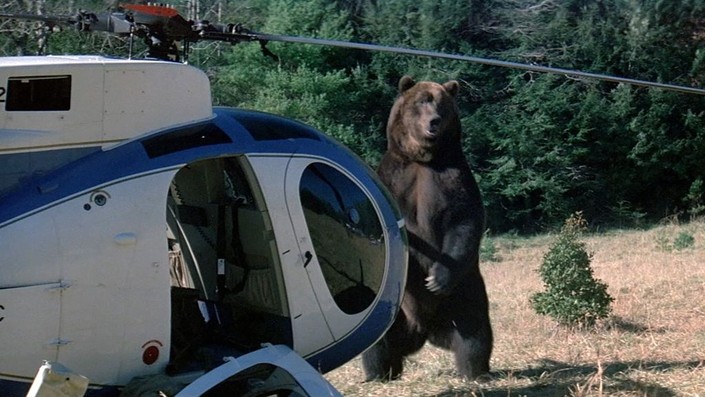
That is, not much else except for Teddy, the glorious 11-foot-tall Kodiak king they brought in to play the shark bear. Wikipedia claims Teddy, the largest bear in captivity at the time, did his on-camera actions in exchange for marshmallows. Citation is needed, but I choose to believe because the image of a giant bear enjoying a little treat, perhaps while wearing a tiny hat, is delightful, even if the reality of feeding trash to bears is starkly the opposite. (DON’T.)
If you haven’t seen Jaws, SPOILERS AHEAD.
We open with sweeping vistas of the woods as Andrew Prine, fully locked into the character of Don, or “Not Quint,” waxes philosophical in a Southern drawl about preserving the national parks and the danger of human encroachment while piloting a helicopter. It’s a decent thesis statement, although any conservation message over the next 90 minutes is a muttered afterthought. That’s ok, though, as the point of the enterprise is to watch campers get mauled by a massive fucking bear, and the film doesn’t make us wait long.
Two co-eds are the first fatalities. A cameraman noses around in the shrubbery near their campsite to heavy, wheezy growling and a curiously familiar music cue2. One girl leaves her friend alone and the unseen bear blasts through the campsite, dismembering the friend in seconds.3 The girl returns to a blood-soaked nightmare of bloody dummy parts and takes off running. She attempts to hide in a cabin only for a crew member wearing a bear sleeve to bust their arm through what I hope is a breakaway wall and maul her.
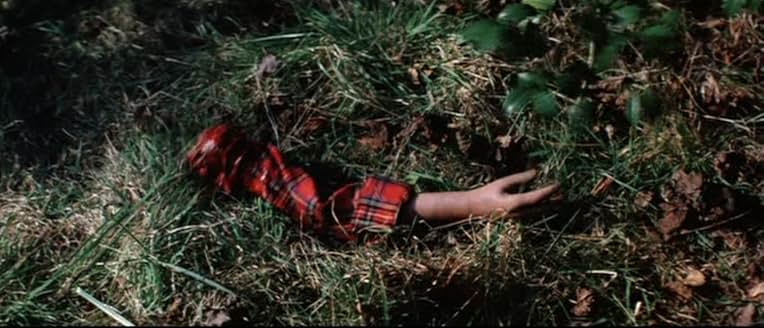
The heightened probability of campers stumbling upon a dismembered human arm is suboptimal on the managerial front, so Sheriff Brody Ranger Kelly (Christopher George), our irritable, maverick hero, is forced to take something resembling action, even though he finds the initial bear hypothesis far-fetched. “Bears don’t eat people,” he asserts incorrectly but with great authority. Ranger Kelly’s smugly commanding demeanor and tendency to condescendingly flirt with every young woman he encounters might have been viewed as ruggedly attractive back in the 70s, but it’s currently 2026 and, frankly, we’re choosing the bear.
Fully closing the park isn’t on the table, per both Ranger Kelly and park supervisor and white-collar nemesis Kittridge (Joe Dorsey), but campers are evacuated from the designated danger zone, and rangers are dispatched to hunt down the rogue bear. And they do find him, or at least one of them does. A young female ranger makes the puzzling choice to strip down and shower under a waterfall because there’s always the one. She meets her end at the claws of the bear sleeve.
It’s funny it takes as long as it does to see the whole bear in this film, given we know they had one on set. Spielberg refrained from showing the shark for much of Jaws because, as wonderful as Bruce is, apart from constantly being on the fritz, that shark is obviously a puppet if you get any sort of look at him. It’s the opposite situation with Teddy, a live bear who’d hit his marks for the price of a marshmallow (citation needed). Of course, to be fair, Teddy squaring off at close range with human actors would probably have ended in catastrophe, so perhaps the takeaway is that some 70s trash cinema projects actually did have a limit to how far they’d go for a spectacle.
After a flimsy excuse to use the helicopter again, it’s time to bring in Scott (Richard Jaeckel), the denim-clad naturalist. Scott, who’s first introduced to us in the midst of a long-term project centered around wearing a fur cape to get some deer to adopt him, knows every bear in the park personally, so he has the authority to declare that this bear isn’t just any bear, but the direct descendant of a million-year-old prehistoric bear, which, technically, aren’t all bears?
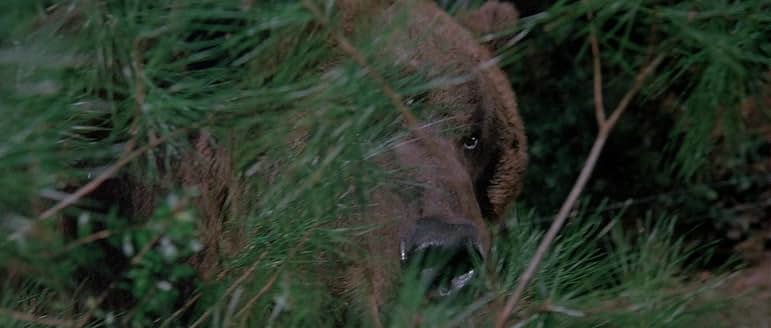
Meanwhile, yet another young woman is violently mangled, so we’re treated to more standing around and irritable bickering about whose fault the bear is. Scott asserts that they’re dealing with a grizzly, and Kittridge snaps, “There are no grizzlies!” as if Scott has suggested female campers are being mauled by feral Smurfs.4
The locals realize the script is stuck in a death loop and swarm the woods to do what the rangers couldn’t. A few hunters try to use a stray cub5 as bait, which just results in them feeding a bear cub to an adult male bear. Scott arrives in the aftermath to lay down some Bear Facts™:
It’s normal for adult male bears to do a cannibalism (TRUE)
The bear is probably not hungry after eating the cub (FALSE)
The bear will return to the scene of his crime (…PASS6)
Teddy puts in some exceptional work in a scene where he creeps up on a ranger tower and deliberately topples it, claiming his first male victim. Teddy is a consummate professional.
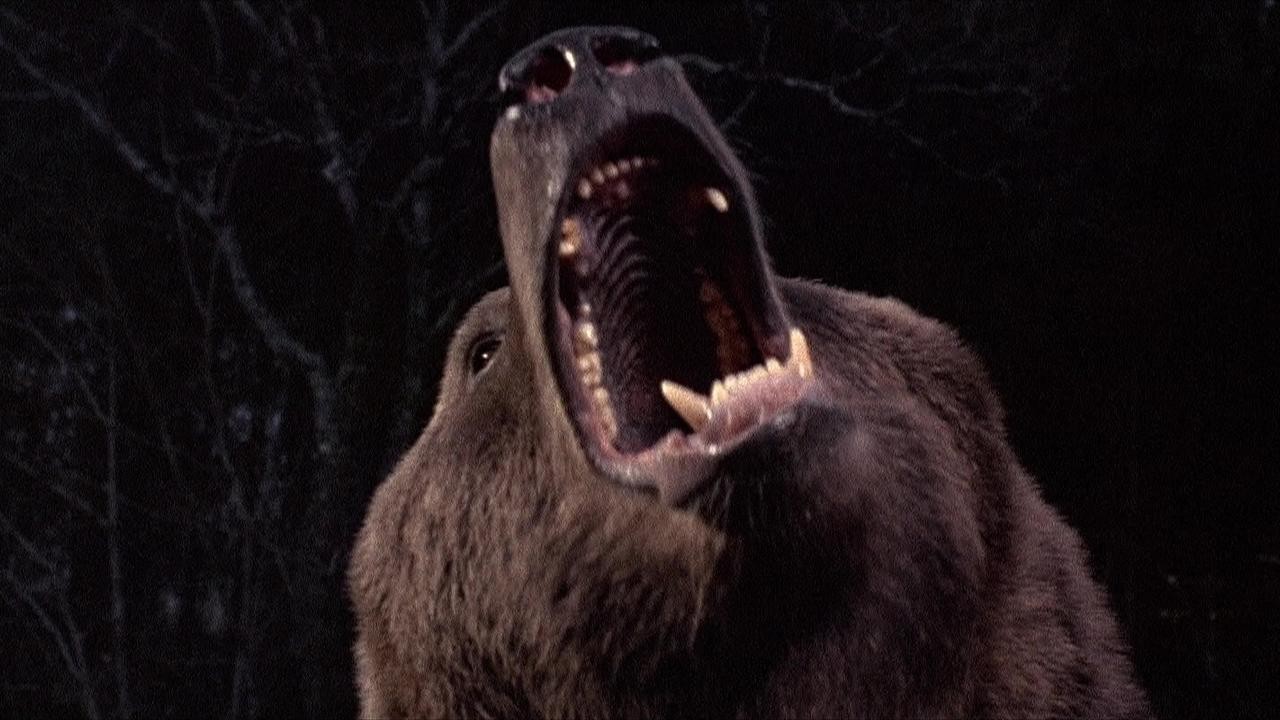
Finally, a mother, young boy, and his enormous pet rabbit are attacked in their own yard. The mother is killed. The young boy is alive but severely injured. The status of the pet rabbit is unremarked upon. After another go-nowhere confrontation with Kittridge, Ranger Kelly decides it’s time to take Action-with-a-capital-A because now he’s double-dog serious. There’s a rift with Scott, who wants to capture the bear alive, so the men split up, with Scott setting out solo while Ranger Kelly and Not Quint make another excuse to fuck around with the helicopter. Scott gets his wish and encounters the bear, fatally.
Ranger Kelly and Not Quint land the chopper and confront the bear. Not Quint engages the bear first with a shotgun, then with the back end of the gun, and finally in hand-to-paw combat before meeting a brutal end that Andrew Prine sells the hell out of. Then Ranger Kelly remembers he packed a deus ex rocket launcher, and the bear explodes, leaving him alone in the clearing to reflect as the credits roll.
Andrew Prine, who is tossed what we’ll generously call four lackluster, Quint-inspired mini monologues to grapple with and manages to land each of them, is the human standout through sheer commitment to the bit, but the film really belongs to Teddy, the Christopher Lee of bears. Teddy beat Leatherface in ticket sales and remained the top indie horror earner for a couple of years until Michael Myers in 1978. That’s not half bad given the script Teddy had to work with.
There’s an alternate universe where Not Quint and the bear realize that they share a similar worldview about preservation and the thrill of the hunt and team up to fly around in the helicopter, thwarting ecoterrorism or deforestation or campers who don’t adequately secure their frankfurters, but apparently that’s not what happens in the curiously star-studded sequel, the release of which was delayed for decades for reasons involving crime.
On some level, Grizzly is an interesting stop on our journey from treating bears as disposable to feting them annually during Fat Bear Week. Overall, the film is more concerned with slaughtering young women, but Grizzly does pay lip service to the importance of monitoring the number of campers in the woods, keeping the forest clear of trash and unsecured people food, and the consequences of bears running low on natural food sources and wandering into human communities.
Ultimately, Grizzly is a Jaws ripoff that manages against all odds to be both endearing and enduring in its own grimy way. Somehow Grizzly isn’t a train wreck, though you wouldn’t be wrong to call it a bear jam. Is there competition between Grizzly and Jaws? Well, the 50-year anniversary just passed for both, and only one got a theatrical re-release and commemorative popcorn bucket, so no, but if Jaws is a meringue, Grizzly is a marshmallow, and, as Teddy would tell you, sometimes a marshmallow is its own reward.
Grizzly is available for free with ads on YouTube and without ads on Prime
- The Office is the name of what was once Otis’s favorite fishing spot at Brooks Falls. ↩︎
- The soundtrack for Grizzly is best described as “Jaws with plausible deniability.” ↩︎
- In bear fan parlance, this is what’s known as “being Grazered.” ↩︎
- What he means is that grizzlies don’t live in the region, but the peeved intensity with which Kittridge asserts “there are no grizzlies” unintentionally adds a new, puzzling layer to the film’s lore. What else doesn’t exist in the world of Grizzly? Do they have bison? Flamingos? Chinchillas? ↩︎
- The “cub” is actually played by an adult black bear, whose name and marshmallow salary are not listed online. ↩︎
- Bears will bury their kill and return to keep eating later, but bears also do not have a concept of “crime” because they are bears. ↩︎